Article
Patent Procurement Is Moving Beyond the Copilot
By Ian Schick, PhD, Esq
The patent AI market has been flooded with copilots. That was a predictable first step. Copilots fit neatly into the old model: the human still runs the workflow, and the software helps the human move faster. In patent work, that usually means quicker drafting, quicker edits, and a somewhat more efficient path through familiar steps.
We do not think that is where the market ends.
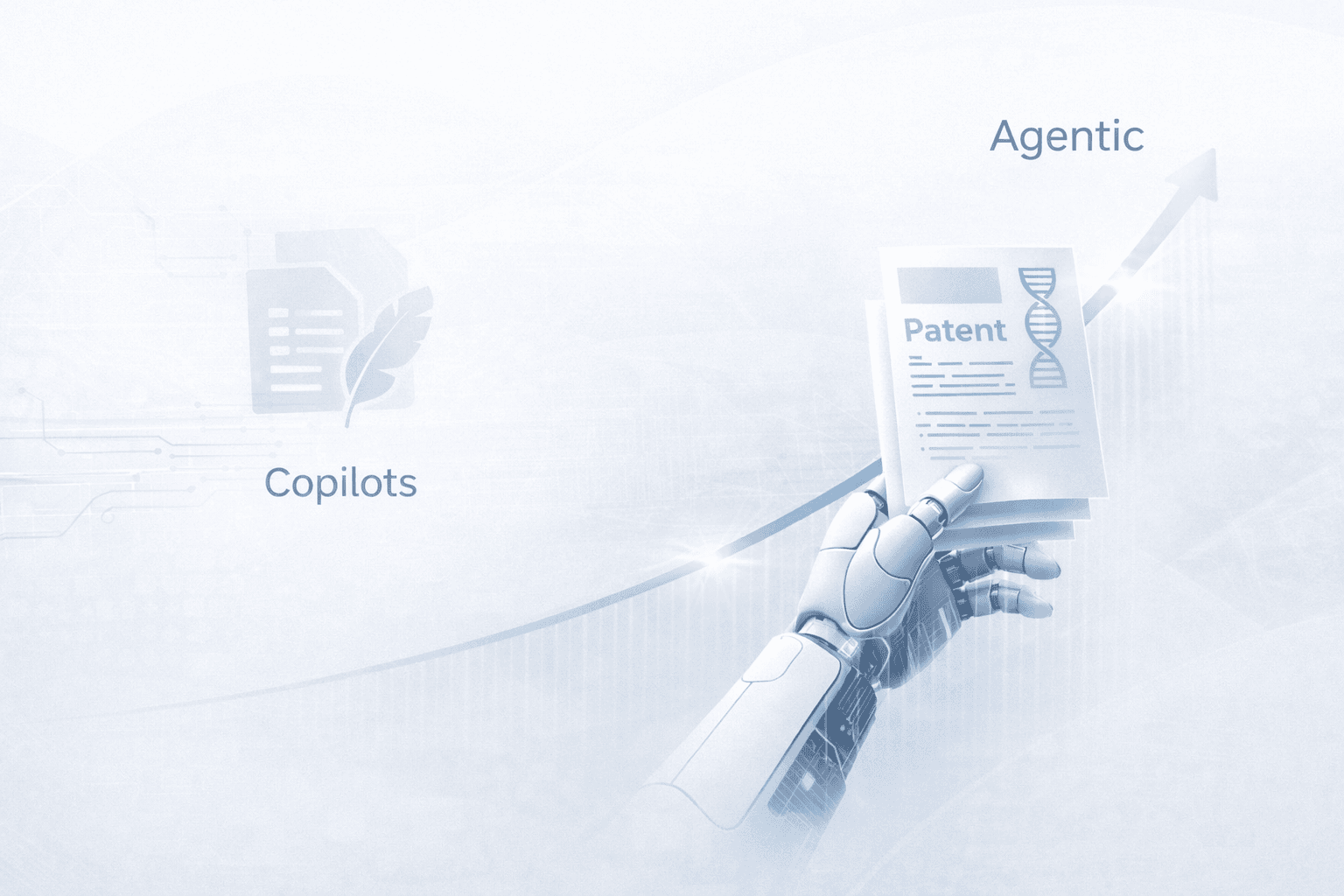
We think patent procurement is moving toward a different model altogether: not software that merely accelerates the old human process, but systems designed to produce excellent work product as the primary output. Sequoia recently advanced a broader version of this thesis in Services: The New Software, arguing that some of the strongest AI businesses will not just assist professionals, but will increasingly own the production layer of intelligence-heavy work. That framework fits patent procurement remarkably well.
Copilots Make the User Faster, but They Do Not Solve the Core Problem
Most copilots are built to improve the operator. In patent drafting, that means the attorney still has to manage the structure of the application, harmonize terminology, maintain consistency across sections, reconcile generated language, and stitch everything together into something coherent and strategically sound.
That can still be useful. But it leaves the hardest part of the job in the same place it has always been: with the person pushing the buttons.
As a result, the output remains highly dependent on the individual user. Quality varies from matter to matter because quality is still shaped by prompting habits, editing skill, tolerance for cleanup, and willingness to manually repair what the system only partially assembled. A faster human process is still a human process. The market may be saturated with copilots, but that does not mean the deeper problem has been solved.
At Paximal, We Built for Output, Not Assistance
At Paximal, our goal has never been to make the old process marginally faster. Our goal has been to use computers to produce excellent patent work product: complete, fully enabled drafts aligned with attorney intent and strategy, and strong enough to be benchmarked against the most valuable patent portfolios in the world.
That is why we have been agentic since 2023.
We did not set out to build a drafting sidekick. We set out to build a production system for patent procurement. Our focus has been on complete work product, not fragmented output. That means drafts that are coherent, internally consistent, strategically aligned, and built for efficient professional review. It also means reducing dependence on the particular habits of the individual user and increasing dependence on a system designed to produce strong results by design.
The Important Divide Is Attorney vs. Portfolio Manager
This shift matters differently to attorneys and portfolio managers, but it matters deeply to both.
For attorneys, the real issue is not whether AI can generate text. The issue is whether the resulting application is actually good. Is it coherent from top to bottom? Does it preserve the intended claim direction? Are the terms harmonized across the document? Are fallback positions and embodiments handled in a way that supports prosecution rather than complicates it? Does the draft reflect legal and strategic direction from the outset, or does the attorney have to reconstruct that logic after the system is done?
For portfolio managers, the concern is broader. They are not buying words. They are overseeing the quality, consistency, and long-term performance of a body of work. They need applications that align with strategy across matters, support a coherent portfolio, and perform at a level that justifies the investment being made. That is not simply a drafting-speed question. It is a production-quality question.
Strong Work Product Changes the Model
Once a system can reliably produce strong work product regardless of which approved user initiates the process, the center of gravity begins to shift. The key question is no longer who is manually generating the first draft. The key question becomes who is setting direction, controlling quality, and making the strategic decisions that shape the portfolio.
That is the real distinction between copilots and agentic systems.
A copilot assumes that the human remains the engine of production and the software provides assistance along the way. An agentic system assumes that software can take on the production layer itself, while the human provides what matters most: judgment, strategy, refinement, and accountability. That is not just a productivity improvement. It is a different operating model.
The Attorney’s Role Becomes Clearer and More Valuable
We do not see this transition as diminishing the role of the attorney. We see it as elevating it.
In a copilot-driven workflow, too much attorney time is consumed by low-leverage drafting mechanics: prompting, patching, cleaning up, revising, and forcing partial outputs to work together. In an agentic workflow, that time can move to higher-value activity. The attorney can focus more on scope, legal judgment, strategic alignment, and final refinement, while the system handles more of the structured intelligence work involved in transforming source materials into a coherent application.
That is the division of labor the market should be moving toward. Attorneys create the direction. The system carries the production burden. The result is not less attorney involvement, but better attorney involvement.
The Next Wave in Patent AI Is About Production
The first wave of patent AI was about assistance. The next wave is about production.
That is why we do not view the current flood of copilots as the end state for the category. Copilots are a transitional form. They fit comfortably into yesterday’s workflow, but they do not fully answer tomorrow’s question, which is how to produce excellent patent work product at scale, with greater consistency, tighter strategic alignment, and a better allocation of human expertise.
That is the future we have been building toward at Paximal. We believe the market is moving beyond tools that merely help a user draft a little faster. The real opportunity is in systems that can produce stronger applications, more consistently, while allowing attorneys and portfolio managers to focus on the decisions that actually determine portfolio value.
The market does not need more drafting assistance. It needs a better production model.