
Article
Prompting Yourself Out of Efficiency
Why copilots create prompt debt—and why agentic systems win
By Ian Schick, PhD, Esq
Copilots promise speed, but they often turn serious work into an endless loop of prompting, re-prompting, and cleanup—where you spend more time managing the model than moving the job forward. The hidden cost is “prompt debt”: fragile instructions that don’t scale, don’t repeat reliably, and quietly increase review and rework. This article argues that the solution isn’t better prompting—it’s a different architecture entirely: agentic systems that own the workflow end-to-end, verify outputs against standards, and pull you in only at the moments where human judgment actually matters.
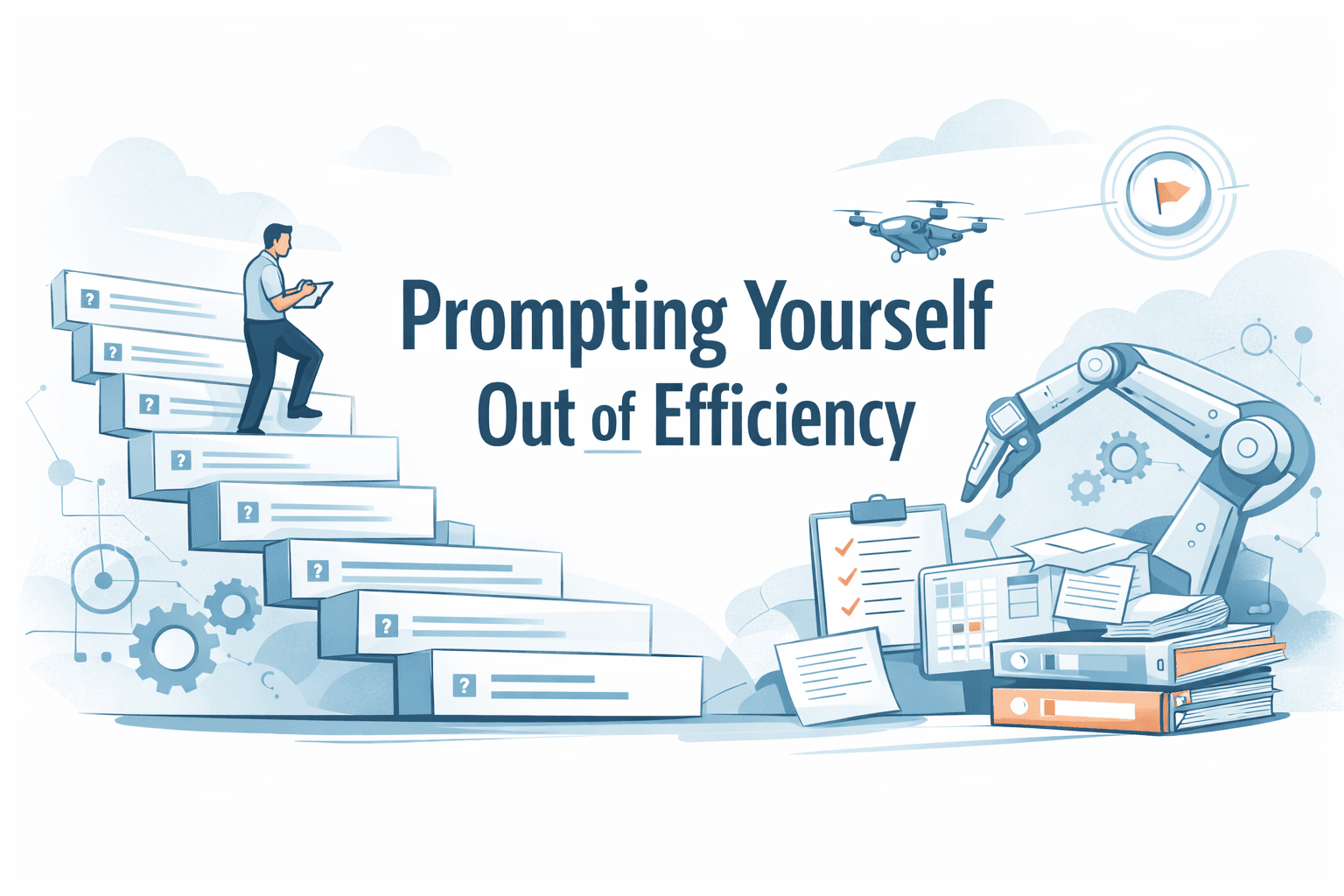
Copilots feel fast—until the work has to be done
Copilots feel like progress because they produce text instantly. You ask, they answer, and a blank page turns into something that looks like work. But when the job is real—when the output has to be complete, consistent, reviewable, and defensible—the copilot loop starts to reveal its cost. You don’t just “get help writing.” You inherit a new responsibility: managing the AI.
That’s the paradox. Copilots promise efficiency, yet they often turn professionals into full-time prompt managers. You spend your time narrating what you want, feeding missing context, correcting drift, reconciling contradictions, and finally packaging everything into a deliverable the way your workflow requires. At the end, you may have more words—but you’re not meaningfully closer to “done.”
The paradox: you can prompt yourself out of efficiency
The core issue isn’t that people are bad at prompting. The issue is architectural. Copilots are optimized for assistive generation: producing helpful fragments on demand. They are not optimized for task completion: driving a structured workflow from inputs to a finished artifact with quality gates along the way. The burden of structure—what comes next, what must match, what must be checked, what must be included—stays with the human. In other words, the workflow doesn’t live in the system. It lives in your prompts.
Prompt debt: the operating cost copilot demos don’t show
Over time, that creates prompt debt. Requirements and decisions end up embedded in ad hoc instructions that aren’t durable, reusable, or enforceable. The same job tomorrow requires re-teaching the same constraints. A different team member gets a different result. An iteration introduces subtle inconsistencies that only show up late, during review. And the more that happens, the more you compensate by adding more context, more instructions, more careful wording—until the “efficiency tool” becomes another layer of work you have to operate.
Why copilots stall out in professional workflows
This is why copilots often scale drafts without scaling throughput. They can accelerate the first 60%—the visible part where something appears on the page—while slowing the last 40%, where professional value actually lives: alignment, completeness, internal consistency, and packaging into a final deliverable. The quality problems aren’t always obvious, either. They’re often the worst kind: plausible, well-written, and subtly wrong. That’s exactly the kind of output that increases review burden rather than reducing it.
The agentic alternative: workflows that run themselves
Agentic systems take the opposite approach. Instead of asking the user to be the workflow engine, an agentic system owns the workflow. “Agentic” doesn’t mean “a chatbot with a stronger model.” It means a goal-driven system that can plan, execute, maintain state, use tools, and verify outputs against explicit standards—then escalate only the decisions that require human judgment.
The difference shows up immediately in how work feels. With a copilot, you steer continuously: rewrite this, incorporate that, now reconcile with earlier text, now format it, now make it consistent, now check whether we covered everything. With an agentic system, you set objectives and constraints up front, and the system runs the steps. It pauses at alignment checkpoints—moments where a human should decide strategy, tradeoffs, or risk posture—then proceeds. The user stops “operating” the AI and starts supervising it in the same way you’d supervise a competent team member: approve the key calls, review the work product, and move on.
Why agentic wins in document production
That’s why agentic systems win in professional document production. Documents aren’t just strings of sentences; they’re structured artifacts with dependencies, definitions, and standards that must hold across sections, versions, and time. A system built to finish the job can track those dependencies, enforce naming and terminology, ensure every required component is present, and run consistency checks before the user ever sees the result. It can be repeatable across matters and teams because success isn’t stored in someone’s prompt-crafting style—it’s embedded in the workflow itself.
The litmus test: where does the process live?
If you’re evaluating AI tools and you want to avoid the prompt tax, the question is simple: where does “the process” live? If it lives in your head and your prompts, you’re buying assisted typing. If it lives in the system—with explicit definitions of done, built-in verification, durable state, and controlled human checkpoints—you’re buying automation.
Bottom line
Copilots made AI approachable, and they’ll remain useful for quick drafting. But for real operational efficiency—especially in high-stakes, document-heavy work—the future isn’t “better prompts.” It’s delegation. Stop prompting your way through workflows. Use systems that can run them.
That’s the path out of efficiency theater—and into actual throughput.