
Article
The Best Drafting Workflows Won't Be Ours: The Paximal MCP and User Innovation
By Ian Schick, PhD, Esq
In 1986, MIT's Eric von Hippel published a finding that broke the standard story of how innovation works. The standard story is linear: a manufacturer does the R&D, ships a product, and users consume it. Von Hippel kept finding the arrow running backward. The most useful innovations were coming from users, the people closest to the problem, who modified what they had to fit needs the manufacturer never anticipated. His "lead users," working at the front edge of a field, turned out to be a richer source of new ideas than the producers serving them. The catch was always the toolkit: user innovation takes off only when the means of building reach the people with the problems.
That's the lens I keep coming back to with the Paximal MCP. Of everything the release does, my favorite thing isn't a feature. It's that it hands the toolkit to practitioners and lets them build patent-drafting workflows we never designed and wouldn't have thought to.
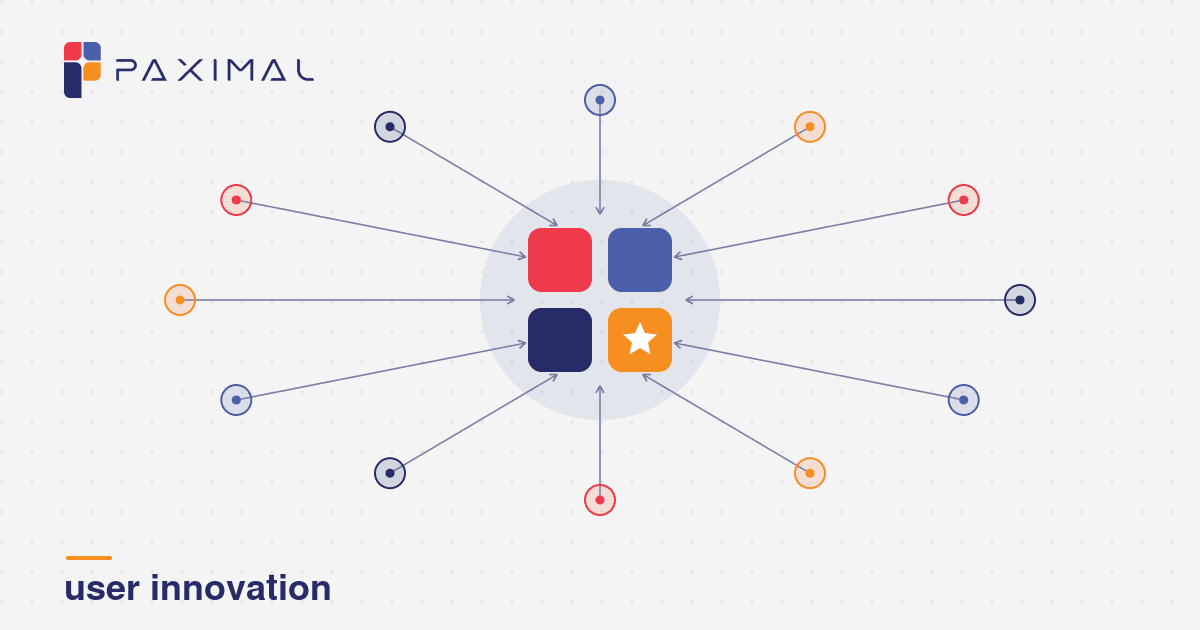
What user innovation is
User innovation is the observation that products get invented, or meaningfully refined, at the site of use rather than the site of manufacture. Products are built for the widest common need; when an individual hits a problem the median user doesn't have, they don't wait for the roadmap. They build the fix themselves. Von Hippel's lead users are the richest version of this, because they're solving for needs the market hasn't articulated yet. The barrier has always been the toolkit. Lower it, and the person with the problem becomes the person with the solution.
Why you can actually build on it
A toolkit only unlocks innovation if people trust what it produces. Hand someone an open-ended LLM and a blank application and you get improvisation: a different result every run, quality that rises and falls with prompting skill. Paximal inverts that. Whatever chat interface you prefer, the applications you generate through the MCP are built the Paximal way: Born Strong™.
In practice that means three things. Your strategy drives the draft through alignment, not prompt gymnastics. You set claim focus, terminology, and embodiments up front, and the output reflects your professional judgment rather than your prompting. The drafting agents scaffold every section, harmonize terminology, map embodiments to claims, and embed fallback support, so the specification is amendment-ready by design. And because your templates and best practices are encoded into the agents, the result is consistent across matters and across users: the same disciplined standard, modeled on world-class portfolios, every time.
That consistency isn't a claim we make lightly; it shows up in the file wrapper. The typical U.S. application grinds through several rounds with the examiner before it reaches allowance, and the large majority draw a rejection on the very first Office action. Most of our case-study cohort got to allowance after a single Office action, with no §112(a) enablement rejections and a fraction of the usual prep time. The full breakdown is in our case study. That's the floor you're composing on.
What practitioners are building
The basics alone earn their keep: coordinating invention-disclosure meetings, patent-specific proofreading, routing reviews and approval emails to the right people at the right stage. Reliable, repeatable, off your plate.
The interesting part is the layer above, the workflows that pack value into an application in ways that weren't practical to do repeatably before:
Prior art. This is the one that should make every prosecutor sit up. An agent can analyze prior-art references and fold what it learns into your claim scope and specification, without ever surfacing the references to you. The strengthening lands in the work product; the references never land on your desk. You get claims hardened against the art without personally acquiring knowledge of specific references you'd then have to evaluate for disclosure.
Prosecution. Shape claims around how applications in the relevant art unit, or in front of the likely examiner, actually move to allowance, drawn from the public record instead of instinct.
Portfolio. Calibrate a draft against your client's own portfolio, or pressure-test it against a competitor's, so each new application strengthens the position rather than sitting beside it.
Market data. Aim claim scope where the commercial value actually is, so protection tracks the business and not just the disclosure.
And then the move that changes the shape of a practice: supervise a roomful of agents at once. Because the MCP exposes each Paximal project as something you can spin up and direct from a single conversation, one attorney can run many drafts in parallel: a whole family of related filings, or a coordinated push to clear a backlog in one technology area, each its own project, each drafting to the same encoded standard. You do what a supervising partner does: set the strategy and alignment for each matter, then review. The agents handle the mechanics. It's more matters at the same headcount, without the consistency tax that usually comes with volume.
The point
This is exactly what von Hippel was describing. The producer can't anticipate every need; the practitioner at the edge of real work can. What changes when the toolkit is both easy and trustworthy is that you stop waiting for the roadmap and start building.
We've said from the start that Paximal exists to amplify attorneys, not replace them, and user innovation is the sharpest version of that thesis. The best workflows on the platform won't be the ones we shipped. They'll be the ones you invent, on your own matters, the week you connect the MCP.
If you're a Paximal customer, connecting the MCP in your preferred chat interface is a short setup step. If you're not yet, schedule a demo and watch a disclosure go from intake to a filing-ready, Born Strong™ draft, then go build something we didn't think of.