AI & Patent Practice
By Ian Schick, PhD, Esq
Maximize priority. Minimize cost. Preserve optionality. Three goals that have traded off against each other for as long as anyone has practiced — and why agentic drafting is what finally lets a client have all three.
Every patent program is trying to do three things at once: claim the most ground from the earliest date, spend the least, and close off no path before it has to be closed.
The first and the third are bought with the same instrument. More filings, earlier, means more priority — and also more live paths, which is what optionality is. They are complements, not rivals. What separates a client from having both is the second item: what a filing costs. That was never a doctrinal limit. It was a price.

Not a trade-off between three things — a budget line. Priority and optionality are complements, not substitutes: more filings buys more of both. Cost is the gate. Lowering the cost per filing widens the gate, which is the whole of the argument below.
The shift — What agentic drafting changed
The biennial Economic Survey of the American Intellectual Property Law Association (AIPLA) never asks how long an application takes, but it reports what practitioners charge to prepare and file one and what their time bills at. The ratio gives an implied-hours benchmark. In the 2025 edition, reporting 2024 charges, it lands at about twenty-six hours of practitioner time for a complex electrical or computer application — seventeen for a minimal one, ten for a provisional. (See our full analysis here).
An agentic system takes a disclosure and returns a complete, filing-ready application under attorney direction — the practitioner sets claim focus, terminology, and embodiments before generation, and verifies the result after. It does not decide what to claim, whether to file, or sign anything. Production collapsed. Judgment did not.
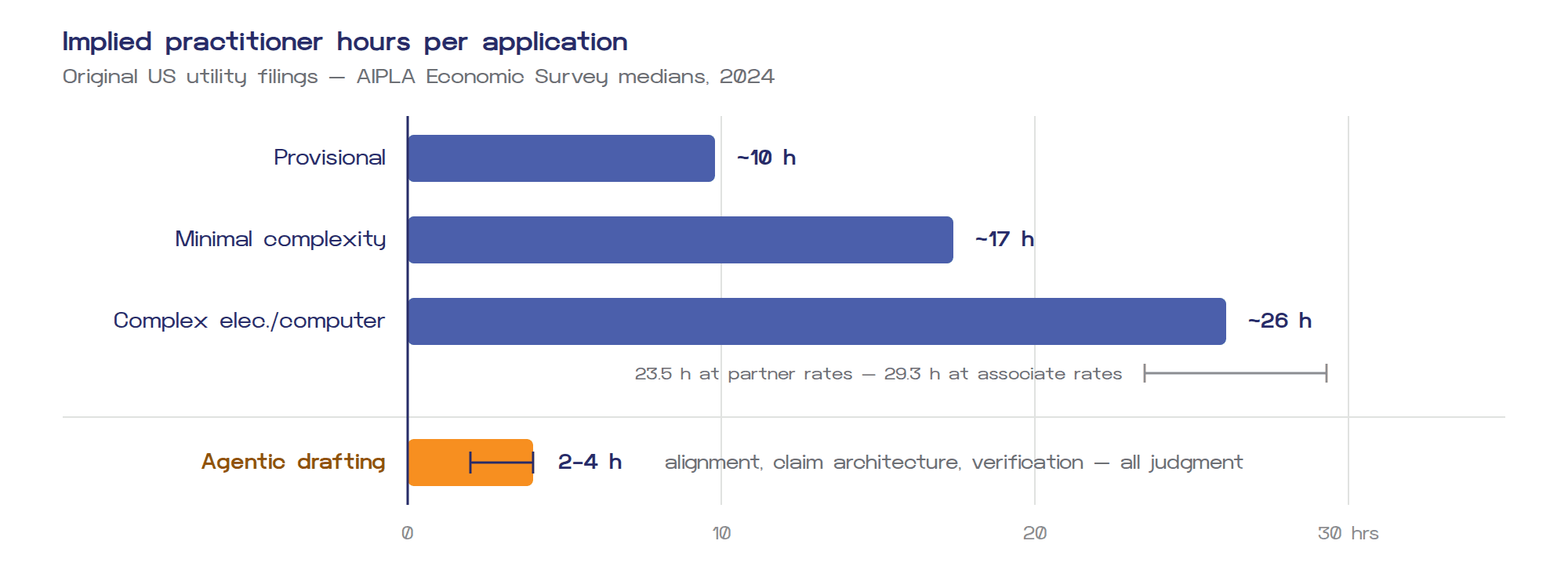
Implied hours = median charge ÷ median blended rate. An economic measure rather than a time study: it conflates effort with delegation and with discounting. The 2–4 hour agentic figure is internal Paximal data for a file-ready draft including attorney review, and is vendor-reported. Twenty-six practitioner hours become two to four. The USPTO’s own Paperwork Reduction Act burden estimate for an original utility application — 40 hours — corroborates the high end.
The assumption to test before relying on any of this
Everything below requires that a two-to-four-hour draft be § 112-equivalent to a twenty-six-hour one — that it enables and describes what it will later be asked to support. That is an assumption, not a finding. No public dataset compares agentic and human drafts on § 112 outcomes, and the hours figure above is vendor-reported. The Office is explicit about where the burden sits: under 37 C.F.R. § 11.18(b), “simply assuming the accuracy of an AI tool is not a reasonable inquiry.” A practitioner who cannot verify written-description support framing by framing, inside the time saved, has not saved the time.
The consequence that matters most
A provisional implies about ten practitioner hours against twenty-six for a complex application. That gap is not by itself proof of thin disclosure — provisionals require no claims, no oath, no formal drawings, and are routinely discounted to win the non-provisional. But it is the shape of a market that prices provisionals as placeholders, and priority does not attach to a filing receipt. It attaches to what the document described and enabled.
Once a complete application costs two to four hours, there is no reason for a provisional to be anything less than one.
In the AI era, the provisional versus non-provisional determination is a filing strategy — not a document production strategy.
The specification is the same either way. What differs is the fee, the clock that starts, and whether examination begins. What does not differ, for priority purposes, is the § 112(a) support burden — and note that it is two burdens: enablement and, separately, written description. Written description is what defeats a later claim the earlier document never showed possession of, and it is the requirement that punishes framing a provisional narrowly and claiming broadly later.
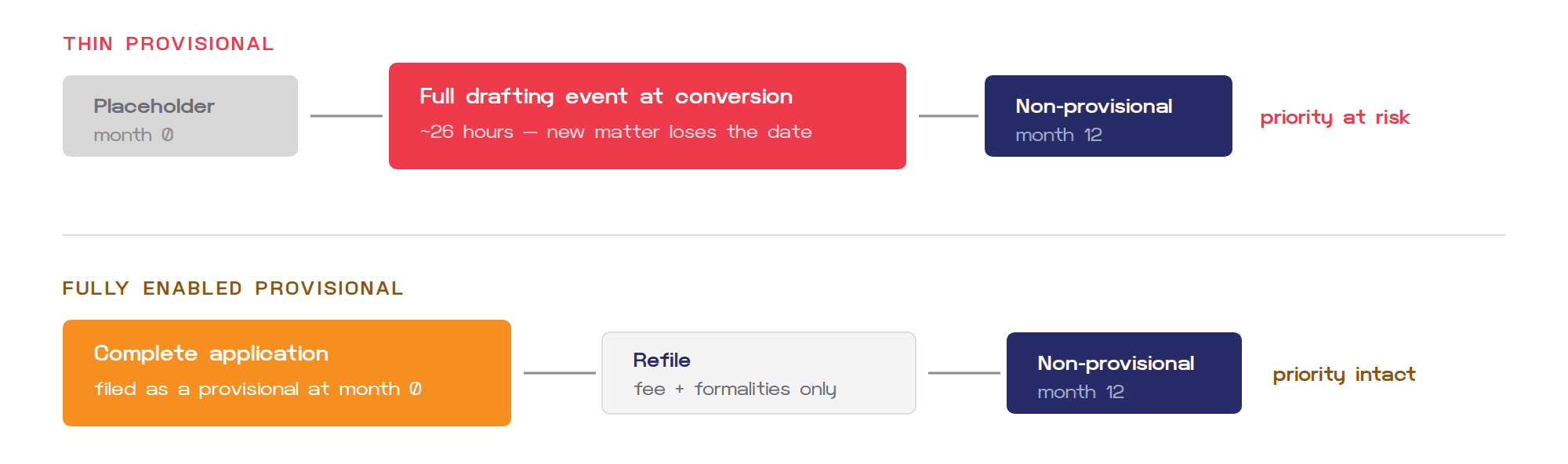
No new matter is added at conversion — so nothing in the priority chain is put at risk by the act of converting.
Do not “convert” a provisional
Here, “convert” means filing a new nonprovisional application that claims the benefit of the provisional, not statutory conversion under 37 C.F.R. § 1.53(c)(3). Actual conversion is a distinct USPTO procedure and is generally less favorable: the converted application retains the provisional’s filing date for patent-term purposes, potentially sacrificing up to twelve months of patent term.
The ordinary and generally preferable approach is to file a new § 111(a) nonprovisional application claiming the benefit of the provisional under § 119(e). That preserves the provisional filing date for supported subject matter without starting the twenty-year patent-term clock on the provisional date. Accordingly, references below to “conversion” mean refiling as a new nonprovisional with a § 119(e) benefit claim, not conversion under § 1.53(c)(3).
AI-Enabled Patent Strategy #1 Rolling Provisionals
A single provisional at month zero protects a snapshot, and a provisional cannot be amended — later matter gets a later date. So file at month zero, file again whenever the technology materially changes, and at month twelve file one non-provisional claiming § 119(e) benefit of all of them, where each claim takes the earliest provisional that supports it.
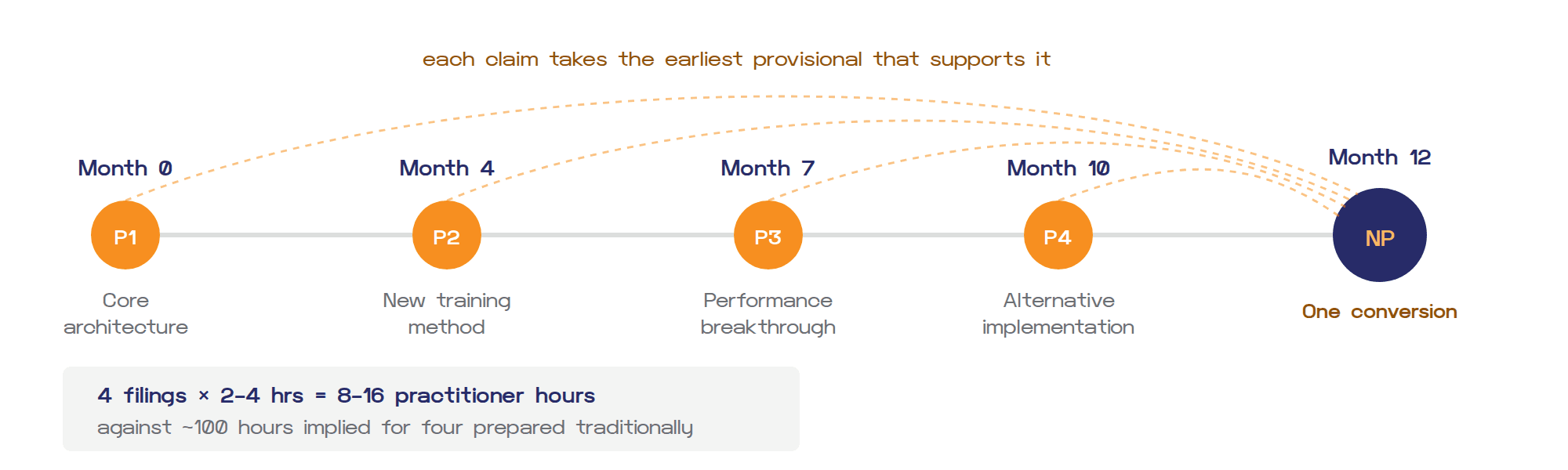
One application. Many priority dates. Some claims in the converged non-provisional trace to month zero, others to month ten. That is the intended result, not a defect in the chain.
A new architecture, a new algorithm, a performance breakthrough with a mechanism behind it, or anything about to be demonstrated publicly warrants a filing. Cosmetic changes and parameter tuning already disclosed as a variation do not. Two cautions the cadence hides: a claim gets the earliest date of a provisional that itself supports the entire claim, since separate provisionals cannot simply be combined to supply missing support, and the applicant carries the burden of proving support for every date it asserts.
Rolling provisionals — scored
Priority | Maximum, subject to support. A separate early date for each advance — but only for claims the corresponding provisional actually described. |
Cost | Two to four practitioner hours per filing, plus the provisional fee and the per-application tool cost. No examination, no prosecution, no conversion decision for twelve months. Provisionals do not count against micro-entity status under 35 U.S.C. § 123(a)(2), and do not consume patent term. |
Optionality | High, not total. An unconverted provisional expires unpublished — but under 37 C.F.R. § 1.14, the provisional file can become publicly accessible once a published application identifies it or claims its benefit. The trade-secret path survives only for provisionals no later filing reaches back to. |
AI-Enabled Patent Strategy #2 Provisional Netting
Month eleven: four related provisionals are still pending. Each has its own specification, covering a different aspect or evolution of the technology, but the client would rather not fund four parallel nonprovisional prosecutions.
Netting turns that into an option rather than an abandonment decision. Choose the commercially important provisional as the lead and file a clean nonprovisional directed to that disclosure. In the new application, claim § 119(e) benefit of all of the related provisionals and expressly incorporate each of them by reference in its entirety. Then prosecute the lead.
The point is not to merge all four specifications into one enormous application. It is to establish a single pending nonprovisional that preserves the benefit chain and keeps the related disclosures available for later prosecution. Each provisional date remains available only for subject matter actually supported by that provisional.
Net the priority chain, not the specifications
The express incorporation by reference matters. A benefit claim alone provides only the limited incorporation afforded by 37 C.F.R. § 1.57(b) for inadvertently omitted material. An express incorporation by reference is broader: incorporated material is treated as part of the application as filed, allowing that disclosure to be carried forward without physically reproducing every provisional in the lead specification. If incorporated material later becomes essential to § 112 support in the lead, it must be brought into the specification under § 1.57(g).
If a non-lead disclosure later becomes commercially important, file a continuation while the lead remains pending, using a clean specification and claims directed to that disclosure. The relevant incorporated material can be included expressly in the continuation rather than left incorporated by reference, and the continuation can claim through the lead to the applicable provisional filing date. So long as the continuation adds no new matter relative to the lead application’s disclosure, it can remain a continuation; genuinely new subject matter would require continuation-in-part treatment.
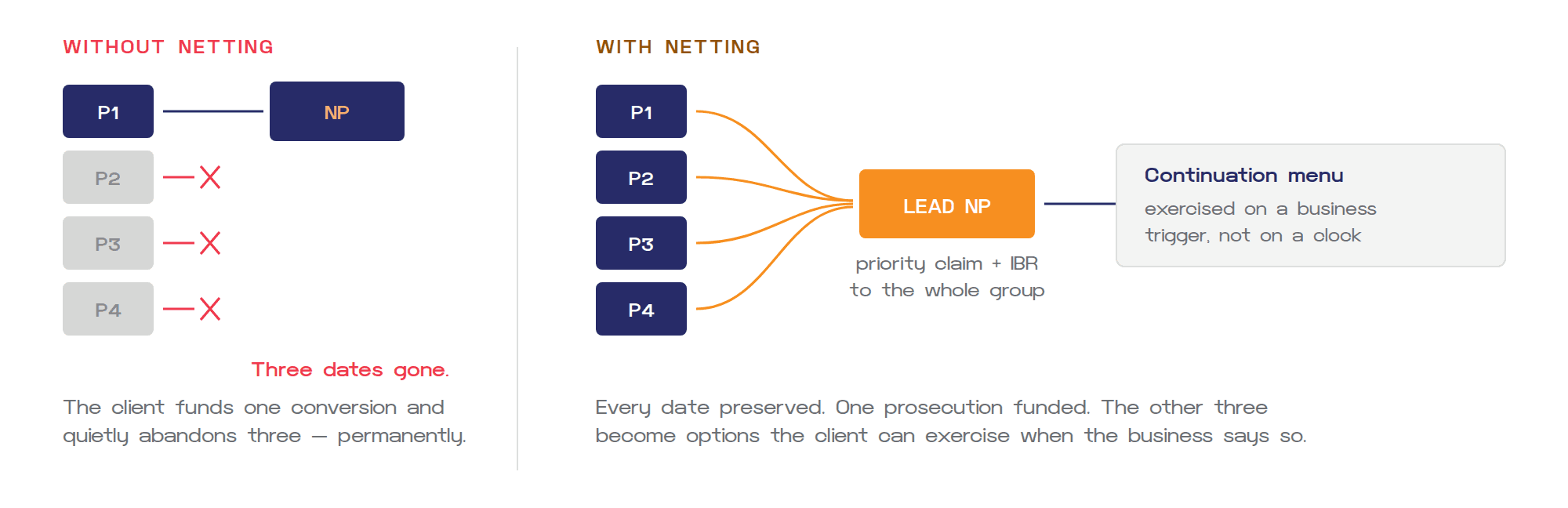
Netting converts an abandonment decision into a deferral decision. Prosecute one disclosure now while preserving the ability to spin the others out later, if their commercial value justifies it.
Provisional netting — scored
Priority | Preserved, date by date. Each provisional date remains available for subject matter it supports, with express IBR preserving the non-lead disclosures for later continuation practice. |
Cost | Prosecution spend deferred. Prosecute one case now; preserve the others for later, without paying to consolidate their specifications. |
Optionality | Deferral has a calendar price. Non-leads become a continuation menu, but the undiscounted § 1.17(w) fee is $2,700 after six years and $4,000 after nine. Provisional benefit does not start that clock. |
AI-Enabled Patent Strategy #3 Cluster Filing
Most inventions can be legitimately claimed several ways — a connected device as a control system, a networked architecture, a signal-processing method, or a device. Which framing the prior art will support is not knowable before filing. Outcomes by classification vary enormously, and it is worth being precise about why.
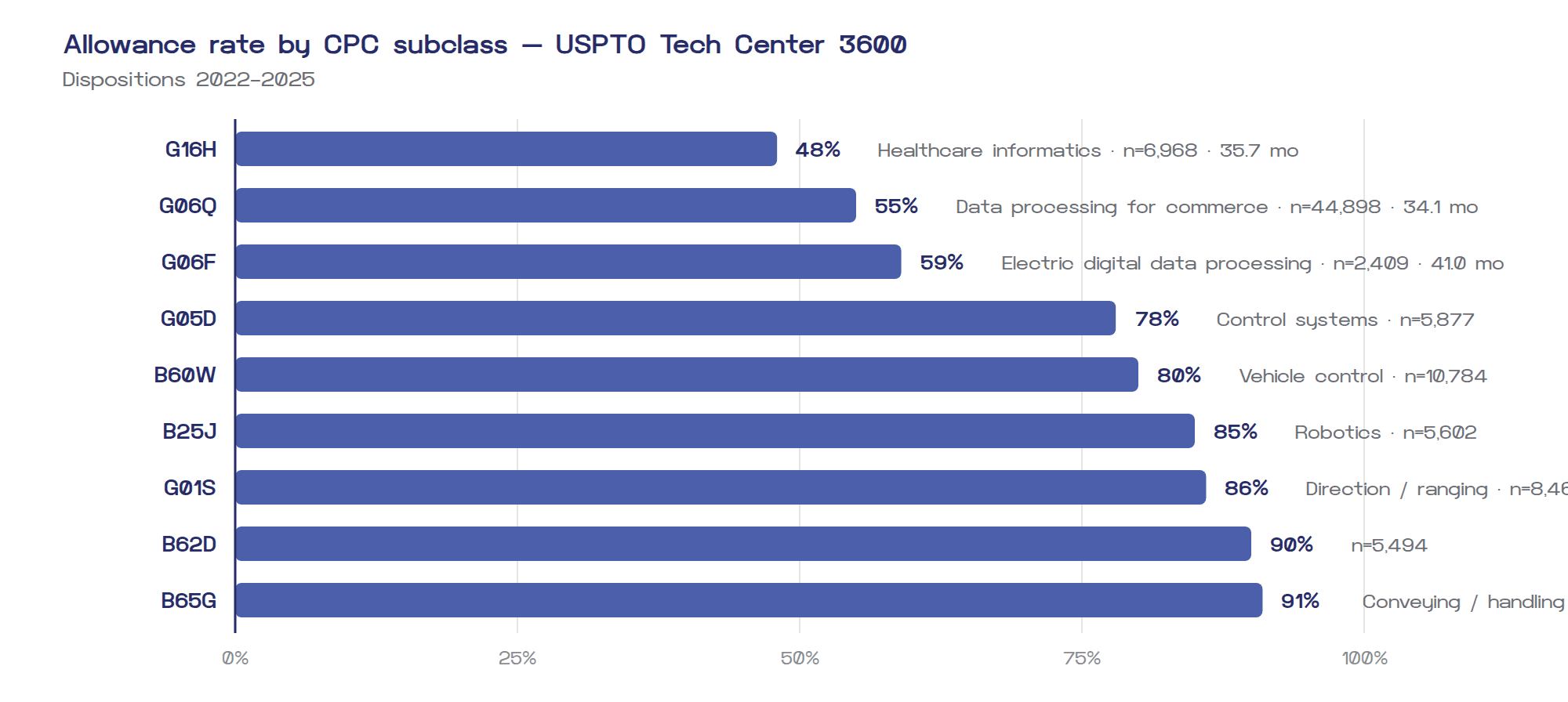
Most of that spread is eligibility, not framing. The three lowest rows carry § 101 rejections at ten to sixty times the rate of the highest rows — a measurement of Alice exposure across unrelated technologies, not evidence that one invention framed two ways gets two outcomes. And the confound does not explain everything: A01G and A01K have almost no eligibility exposure and still sit in the fifties and sixties. Rows are the largest subclasses by disposition count, plus those two counter-examples. Source: Juristat USPTO dataset.
What this does and does not license
It does not license reframing a business method as a control system to escape Alice. Eligibility follows what the claim recites, and a claim to an abstract idea does not become eligible by landing in a different art unit. What the data supports is narrower and still sufficient: where a case lands materially changes its prosecution, and the practitioner cannot know in advance which of several legitimate framings the art will support. That argues for keeping more than one alive — for inventions that genuinely admit more than one technical characterisation.
Traditionally the answer emerged only by losing: file, reject, amend, RCE, then a continuation with a different framing — six to eight years and three prosecution budgets, every one of those years a year the option stayed closed.
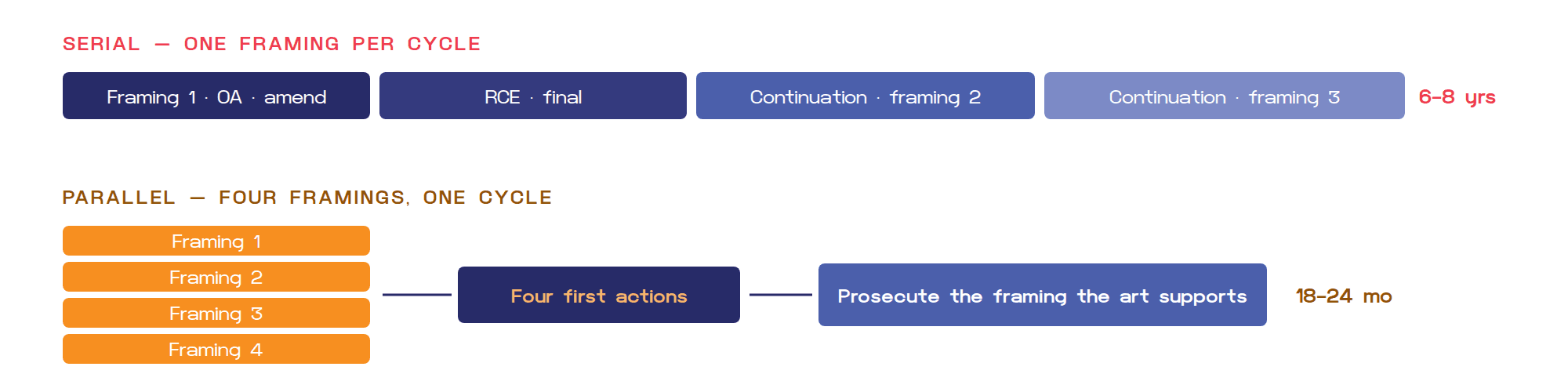
Serial versus parallel. The traditional path spends years and three prosecution budgets to learn what a cluster learns in one cycle for one prosecution budget — and the three unsuccessful framings publish along the way.
Four members will not report together
The premise is that the members classify differently — so they route to different art units, and the same Juristat data puts these subclasses between roughly 24 and 41 months to disposition. First actions can arrive a year or more apart, and the earlier ones will demand a response long before the later ones exist. Three ways to handle it, all of which cost money the plain plan does not show: Track One on every member (37 C.F.R. § 1.102(e)) to compress first actions to roughly four to six months, at $1,806 small-entity each plus a $60 processing fee, and within Track One’s four-independent / thirty-total claim limits; deferral of examination on the fast members (37 C.F.R. § 1.103(d)), which must be requested before a first Office action or notice of allowance, while the application is in condition for publication and is not subject to a nonpublication request, and may extend no later than three years from the earliest claimed benefit date; or budget a substantive response in the fast member and accept that the survivor is chosen on partial information.
The three abandoned members are defensive publications
Under § 122(b) applications publish at eighteen months from earliest priority — for a cluster refiled at month twelve, months before any first action. What the client gets is three published applications, indexed and classified where examiners actually search, which is more than a blog post or a repository achieves.
Describe the cost honestly, because it is the largest irreversible act in the programme. A defensive publication does not foreclose competitors from patenting improvements or non-obvious species; it is prior art for what it discloses and enables, no more. It permanently ends the trade-secret election for that subject matter. And it collides with the client’s own later work: after the § 102(b)(1)(A) grace year, the client’s own publications are citable § 102(a)(1) art against its own improvement filings. Europe offers no comparable common-ownership safe harbor: an earlier EP or qualifying Euro-PCT filing can become Article 54(3) prior art for novelty, while an already-public disclosure can become ordinary Article 54(2) prior art.
Nonpublication requests, and the trap in them
A request under 37 C.F.R. § 1.213 keeps an application from publishing, which preserves the trade-secret election. It does not work member by member: all four share one disclosure, so holding one back while three publish preserves nothing. Keeping the election means holding back the entire cluster, forfeiting the defensive publications, and certifying that the subject matter will not be the subject of an application filed abroad or under any multilateral agreement — which bars a PCT filing, including one designating only the United States.
When the first actions do arrive, weigh: any § 101 rejection, the type of prior-art rejection, what scope survived, and which framing reads on what a competitor ships. Note that a slow art unit is not purely a cost — it can generate patent term adjustment under § 154(b), subject to statutory USPTO delays and any applicant delay, so speed and term point in opposite directions.
Cluster filing — scored
Priority | Shared, subject to support. All four carry the same earliest dates — for the framings the provisionals actually described. A control-system disclosure frequently will not support a signal-processing claim. |
Cost | Higher in year one, lower per framing. Four filing fees, four tool charges, eight to sixteen practitioner hours, one full prosecution — plus Track One or deferral fees to make the timing work. Each cluster member counts toward the § 123(a)(2) filing limit, so a four-application cluster can rapidly consume micro-entity headroom. |
Optionality | Expanded on the patenting axis; closed on the secrecy axis. Four framings alive and chosen after seeing the art — bought by spending the trade-secret election permanently, and by accepting three publications that become prior art against the client’s own later filings. |
Who captures this?
Implied hours have barely moved across six AIPLA editions. Through 2024 there is no sign that drafting automation has reached fee benchmarks at all — which admits two readings: the gains are not yet real at scale, or they are real and being kept as margin. If the second, the beneficiary of everything above is the firm, not the client.
That is a Rule 1.5 question, and ABA Formal Opinion 512 answers part of it: a lawyer may not bill hours not expended, and a flat fee that ignores a large efficiency gain may be unreasonable. AI-tool charges should be handled transparently. Absent an advance agreement establishing a specific charge, separate billing generally should reflect the direct cost of the tool and a reasonable allocation of directly associated expenses. The strategies above are worth more to a client than a single filing was; they are not worth twenty-six hours of billing for four hours of work.
In closing — The constraint, not the law
The objectives were always compatible in principle. What was not obvious — and is not an afternoon’s thought — is the construction that reconciles them: a provisional drafted to non-provisional completeness, refiled rather than converted, with related provisional disclosures preserved through express incorporation by reference and future continuation practice rather than copied into the lead, siblings that share § 119(e) and deliberately do not claim § 120 of each other, and a timing plan for first actions that will not arrive together. Each of those is a specific choice with a specific way to get it wrong.
What AI contributed is narrower than the strategies it enables. It did not make anyone a better patent lawyer and it did not open a door in the statute — the AIA redesignated § 112 without disturbing what enablement and written description require, and its move to first-inventor-to-file only made an early date worth more. What changed is the price of a complete document, and with it the number of complete documents a client can hold at once.
The trade-off did not vanish. The frontier moved — far enough that a client can now hold four framings and a year of dated disclosure for about the practitioner time that used to buy one application. That is not all three for free. It is considerably more than two.
Sources & notes
Prosecution outcome data: Juristat USPTO dataset, Technology Center 3600, dispositions 2022–2025, aggregated by CPC subclass.
Practitioner time: AIPLA Report of the Economic Survey, 2015–2025 editions (typical-charge tables for US utility patents; billing-rate tables by role, firm size and location), analysed as implied hours = median charge ÷ median rate. Corroborating upper bound: USPTO, Initial Patent Applications, OMB Control No. 0651-0032 (82 Fed. Reg. 10836).
Practitioner duties: Guidance on Use of Artificial Intelligence-Based Tools in Practice Before the USPTO, 89 Fed. Reg. 25609 (Apr. 11, 2024). Revised Inventorship Guidance for AI-Assisted Inventions, 90 Fed. Reg. 54636 (Nov. 28, 2025). ABA Formal Op. 512 (July 29, 2024).
Statute: 35 U.S.C. § 112, as redesignated by the Leahy-Smith America Invents Act, Pub. L. 112-29, § 4(c) (eff. Sept. 16, 2012); first-inventor-to-file, id. § 3 (eff. Mar. 16, 2013).
Fees: Application size fee, 37 C.F.R. § 1.16(s). Continuing application and IDS size fees, §§ 1.17(w) and 1.17(v), as set by 89 Fed. Reg. 91898 (Nov. 20, 2024), effective Jan. 19, 2025.
Nothing here is legal advice, and every filing decision described depends on facts specific to a client and an invention.