
AI & Patent Practice
By Ian Schick, PhD, Esq
What 37 CFR 11.18 actually certifies — and why the Office’s own manual says so.
There is a criticism of AI-assisted patent drafting that has hardened into conventional wisdom faster than anyone bothered to check it. It runs like this: a practitioner who prepares an application in a fraction of the traditional time cannot have made the “inquiry reasonable under the circumstances” that 37 CFR 11.18(b)(2) requires. Fewer hours, less inquiry. Less inquiry, unreasonable inquiry. Unreasonable inquiry, a Rule 11.18 problem.
The argument has the shape of common sense, which is why it circulates without much resistance. It is also wrong at the second step, and the authority establishing that it is wrong is not obscure. It is in the Manual of Patent Examining Procedure, in the section the Office wrote specifically to explain what reasonable inquiry means. Reasonable inquiry has never been measured in hours. It has never been measured in effort at all.

Read the rule closely
Start with what 37 CFR 11.18 actually certifies, because the two subsections do different work and the difference matters.
Subsection (b)(1) certifies that all statements of the party’s own knowledge are true, all statements on information and belief are believed to be true, and all statements are made with knowledge that whoever knowingly and willfully falsifies a matter within the Office’s jurisdiction is subject to the penalties of 18 U.S.C. 1001. Note what is absent: there is no reasonable-inquiry qualifier here. Statements of fact must simply be true. Diligence is not a defense to a false statement of fact, and no amount of process cures one.
Subsection (b)(2) is where reasonable inquiry lives, and it attaches to four enumerated things — not to the document as a whole. To the best of the party’s knowledge, information and belief, formed after an inquiry reasonable under the circumstances, the paper is not presented for an improper purpose; the legal contentions are warranted; the factual contentions have or are likely to have evidentiary support; and the denials of factual contentions are warranted.
Four certifications. That is the scope of the inquiry duty. The rule does not certify that the specification is good, that the claims are well-scoped, that the embodiments are thorough, or that the practitioner worked hard. Those are real professional obligations with real consequences. They are not what 11.18(b)(2) is about.
The Office’s own gloss: cost-justification
MPEP § 410 is where the USPTO explains this rule to practitioners, and it does not leave “reasonable inquiry” undefined. The Office reaches for Rule 11 jurisprudence — 11.18(b)(2) tracks Fed. R. Civ. P. 11(b) almost verbatim — and adopts this formulation:
the amount of investigation required by Rule 11 depends on both the time available to investigate and on the probability that more investigation will turn up important evidence; the Rule does not require steps that are not cost-justified.
Hays v. Sony Corp. of America, 847 F.2d 412, 418 (7th Cir. 1988), quoted in MPEP § 410.
Read the last clause again. The rule does not require steps that are not cost-justified. The Office has adopted an expressly economic standard for reasonable inquiry. The metric is not how much work was done. It is whether the investigation that was performed was proportionate to the probability that further investigation would have turned up something that mattered.
That is a sliding scale by design, and it always has been. An inquiry is not deficient because it was quick. It is deficient only if a cost-justified step was skipped.
The duty that does not exist
MPEP § 410 then disposes of the single largest assumption underlying the hours critique:
the “inquiry reasonable under the circumstances” requirement of 37 CFR 11.18 does not create any new duty on the part of an applicant for patent to conduct a prior art search.
And more flatly: an applicant has no duty to conduct a prior art search as a prerequisite to filing an application for patent. The Office cites four Federal Circuit decisions for the proposition — Nordberg, Inc. v. Telsmith, Inc., 82 F.3d 394, 397 (Fed. Cir. 1996); FMC Corp. v. Hennessy Industries, Inc., 836 F.2d 521, 526 n.6 (Fed. Cir. 1987); FMC Corp. v. Manitowoc Co., 835 F.2d 1411, 1415 (Fed. Cir. 1987); and American Hoist & Derrick Co. v. Sowa & Sons, Inc., 725 F.2d 1350, 1362 (Fed. Cir. 1984).
When non-practitioners imagine what a “reasonable inquiry” before filing must involve, searching the art is usually the first thing on the list and the most expensive. It is expressly not required. Practitioners know this; the people forming opinions about how long an application ought to take often do not, and the gap between routine good practice and actual regulatory duty is where most of the confusion about AI-assisted drafting lives.
This is not permission to ignore what you know. The duty of disclosure under 37 CFR 1.56 is untouched: material information actually known must be submitted. But the distinction between a duty to disclose what you know and a duty to go find out is the difference between a bounded obligation and an unbounded one, and the Office has been clear about which one 11.18 imposes.
So what does the inquiry actually cover?
Here is the part that gets lost. Unlike a litigation pleading — where nearly every sentence is a factual or legal contention subject to Rule 11 — an original patent application makes remarkably few representations of the kind 11.18 certifies. Enumerate them and the list is finite.
Inventorship. Who conceived the invention. Unless a person contributes to the conception of the invention, he is not an inventor. In re Hardee, 223 USPQ 1122, 1123 (Comm’r Pat. 1984). Inventors are statutorily “individuals.” Thaler v. Vidal, 43 F.4th 1207, 1211 (Fed. Cir. 2022). This is confirmed with human beings or it is not confirmed.
Entity status. Small and micro entity certifications under 37 CFR 1.27 and 1.29 — historically among the most disciplined-upon misrepresentations in all of prosecution, and among the easiest to get wrong by inheriting a status from a sibling matter.
The correspondence between the disclosure and the actual invention. The specification must convey with reasonable clarity that, as of the filing date sought, the inventor was in possession of the invention as claimed. MPEP § 2163; Ariad Pharmaceuticals, Inc. v. Eli Lilly & Co., 598 F.3d 1336, 1340 (Fed. Cir. 2010) (en banc); Vas-Cath, Inc. v. Mahurkar, 935 F.2d 1555, 1560 (Fed. Cir. 1991).
Known material art. 37 CFR 1.56, per above.
Affirmative statements of fact in the document. Characterizations of the prior art in the background. Priority claims. Incorporations by reference. Statements about what was made, measured, or tested.
The prophetic/actual distinction. Working examples correspond to work actually performed; paper examples describe an embodiment that has not actually been conducted. And the line that deserves more attention than it gets: paper examples should not be described using the past tense. MPEP § 608.01(p), citing Hoffman-La Roche, Inc. v. Promega Corp., 323 F.3d 1354, 1367 (Fed. Cir. 2003).
Proper purpose. The paper is not filed to harass, delay, or needlessly increase costs. 37 CFR 11.18(b)(2)(i).
Seven items. Not one of them scales with the length of the specification. Several take minutes — if you have something to check against. Several take a great deal longer if you don’t, because you are reverse-engineering a finished document to discover what it asserted.
Two kinds of attorney time
The certification layer is what you must personally know and verify in order to sign. It is short, enumerable, and — the crucial property — it does not scale with the length or complexity of the document. A forty-page specification and a twelve-page specification have the same seven items.
The craft layer is everything else: claim scope strategy, fallback positions, embodiment coverage, prosecution positioning, prose quality. This is where the bulk of traditional preparation time went, and it is enormously valuable. It is a question of client service, competence, and malpractice exposure. It is not a question of Rule 11.18.
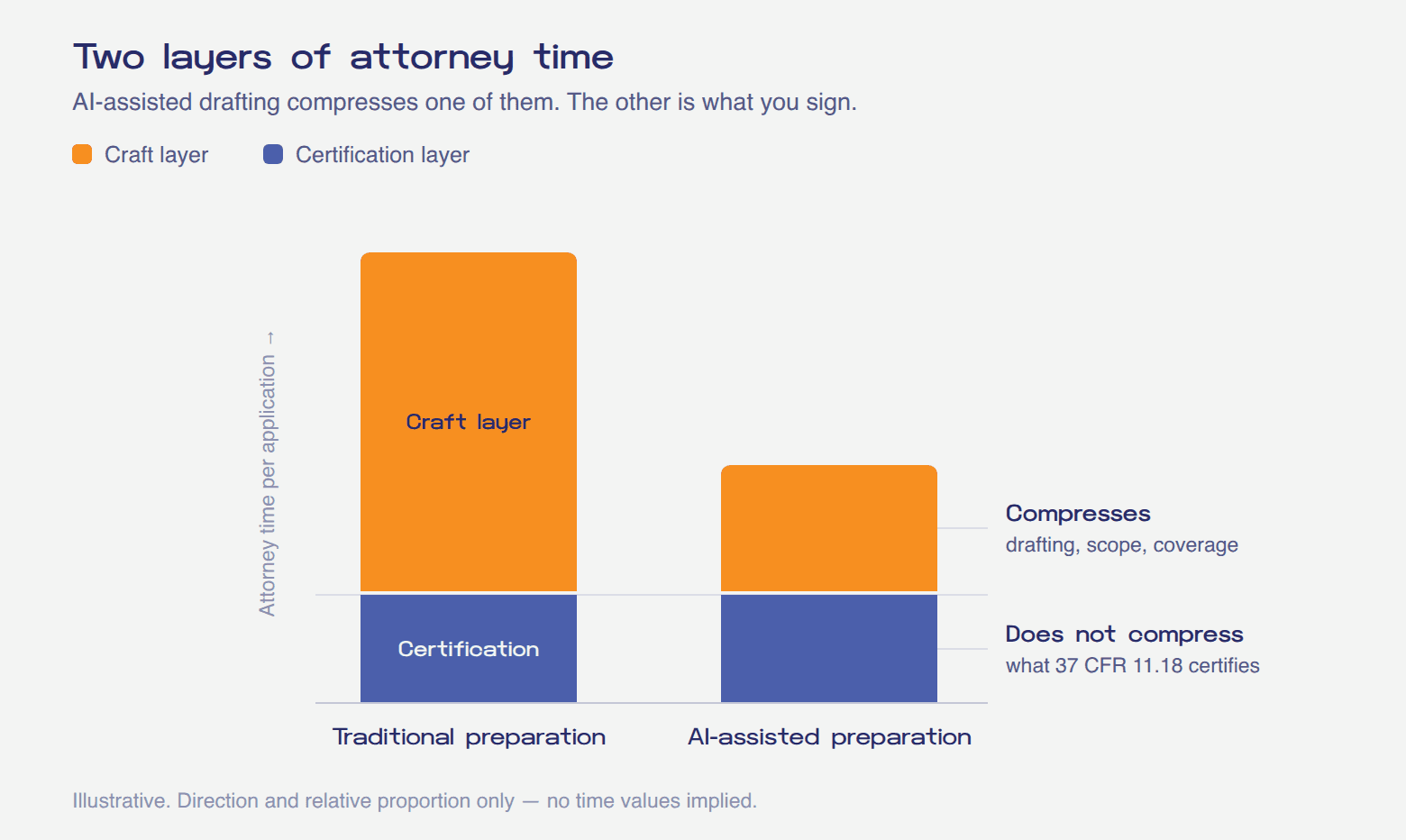
The compression is real, and it is not uniform. Direction and relative proportion only — the figure asserts no time values, because none are necessary to the point.
The hours critique lands only if you assume the two layers are the same thing, so that compressing one necessarily compresses the other. They are not the same thing, and the Office’s own framework — four certifications, cost-justified investigation, no search duty — is built on the distinction. Which is also why “I spent a lot of time on it” is such weak evidence of compliance. Effort is a proxy people reach for because verification is hard to observe from the outside. It was never the standard.
The honest complication
Hays cuts in both directions, and anyone building on it should say so before someone else does. If reasonable inquiry is a cost-justification test, then when the cost of a verification step falls, the case for performing it gets stronger, not weaker. Tooling that makes it cheap to trace every claim term to its support in the specification, or to check every factual statement against the inventor’s source material, does not excuse those checks. It arguably makes them expected.
This is the right outcome, and practitioners should welcome it. It replaces a standard nobody can actually measure — did you work hard enough? — with one that is concrete, auditable, and improvable: did you verify what was cheap to verify, and can you show it?
That standard is harder than the folk version in one respect. It does not let anyone off on the grounds that they billed a lot of hours. But it is also the only version that survives contact with how patent applications are actually prepared in 2026, at any firm, with any toolset.
The question to ask instead
The USPTO has made its own position on filing integrity unusually clear this year. Its final rule requiring foreign applicants and patent owners to be represented by a registered practitioner — effective July 20, 2026 — responds to a filing-quality problem by routing more applications through the practitioner’s signature, reiterating that the presentation to the Office of any paper by a party, whether a practitioner or non-practitioner, constitutes a certification under 37 CFR 11.18(b). Required Use by Foreign Applicants and Patent Owners of a Patent Practitioner, 91 Fed. Reg. 13510 (Mar. 20, 2026) (final rule).
The Office is betting on the certification, not on examination, as the mechanism that keeps the filing stream honest. That bet only pays if practitioners have a clear, workable account of what the certification actually requires — one that scales with volume rather than collapsing under it.
“How long did you spend on it” is not that account. It never was. The question the rule actually asks is narrower, harder, and far more useful: What did you verify, and how do you know?
Authorities
Regulations
37 CFR § 11.18 — Signature and certificate for correspondence filed in the Office
37 CFR § 1.56 — Duty to disclose information material to patentability
37 CFR §§ 1.27, 1.29 — Small and micro entity status
37 CFR § 1.63 — Inventor’s oath or declaration
Fed. R. Civ. P. 11(b)
MPEP
MPEP § 410 — Representations to the U.S. Patent and Trademark Office
MPEP § 608.01(p) — Completeness of specification; working and prophetic examples
MPEP § 2004 — Aids to Compliance With Duty of Disclosure
MPEP § 2109 — Inventorship
MPEP § 2163 — Written description requirement
Cases
Hays v. Sony Corp. of America, 847 F.2d 412 (7th Cir. 1988)
Nordberg, Inc. v. Telsmith, Inc., 82 F.3d 394 (Fed. Cir. 1996)
FMC Corp. v. Hennessy Industries, Inc., 836 F.2d 521 (Fed. Cir. 1987)
FMC Corp. v. Manitowoc Co., 835 F.2d 1411 (Fed. Cir. 1987)
American Hoist & Derrick Co. v. Sowa & Sons, Inc., 725 F.2d 1350 (Fed. Cir. 1984)
Hoffman-La Roche, Inc. v. Promega Corp., 323 F.3d 1354 (Fed. Cir. 2003)
Ariad Pharmaceuticals, Inc. v. Eli Lilly & Co., 598 F.3d 1336 (Fed. Cir. 2010) (en banc)
Vas-Cath, Inc. v. Mahurkar, 935 F.2d 1555 (Fed. Cir. 1991)
Thaler v. Vidal, 43 F.4th 1207 (Fed. Cir. 2022)
In re Hardee, 223 USPQ 1122 (Comm’r Pat. 1984)
Agency guidance
Guidance on Use of Artificial Intelligence-Based Tools in Practice Before the USPTO, 89 Fed. Reg. 25609 (Apr. 11, 2024)
Duties of Disclosure and Reasonable Inquiry During Examination, Reexamination, and Reissue, 87 Fed. Reg. 45764 (July 29, 2022)
Properly Presenting Prophetic and Working Examples in a Patent Application, 86 Fed. Reg. 35074 (July 1, 2021)
Required Use by Foreign Applicants and Patent Owners of a Patent Practitioner, 91 Fed. Reg. 13510 (Mar. 20, 2026) (final rule, eff. July 20, 2026)