
AI & Patent Practice
By Ian Schick, PhD, Esq
The 50-patent club shrank for a decade, and not evenly. Every output band below 1,000 patents a year contracted. One grew 41%.
Nine years ago, IPWatchdog listed every firm that put its name on at least 50 issued U.S. utility patents. There were 803. PatentBots now ranks every firm the same way for the year ending Q1 2026: 709 clear the bar.
The list came up ninety-four firms shorter, and the patents kept coming. The USPTO issued 318,828 utility patents in 2017 and about 325,800 in 2025. Same output, ninety-four fewer firms producing it at scale.

Not evenly. From the bottom.
Firms issuing 1,000 or more patents a year went from 46 to 65, up 41%, while everything beneath them lost ground. Their share of all patents on the list went from 34.6% to 45.5%. Sixty-five firms now account for nearly half the output. That is the Matthew Effect I argued was coming to patent drafting, except it didn’t wait for AI. It ran for nine years on the old economics.
The erosion was worst at the bottom. The 50–74 band lost 27.6% of its firms, more than double the list’s overall decline. The median firm rose from 139 patents to 165. The nominal bar stayed at 50; the real one moved.
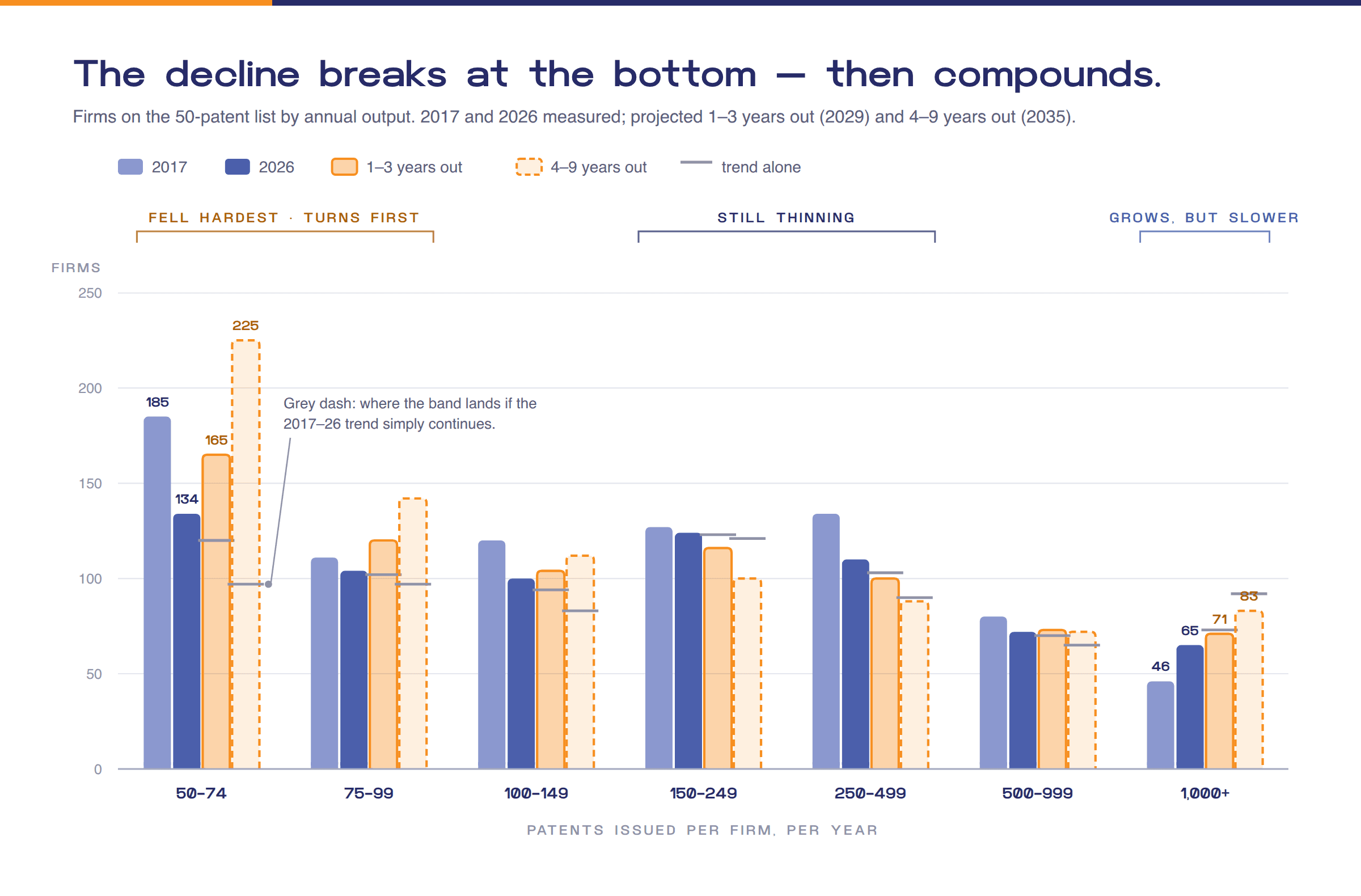
Figure 1. Firms on the 50-patent list by annual output. 2017 and 2026 measured; projected 1–3 years out and 4–9 years out. The grey dash marks where each band lands if the 2017–26 trend simply continues.
Fifty was always a headcount.
A firm produces 50 patents a year because it employs enough people to type them — twenty to thirty hours an application of stitching prose, harmonizing terminology, chasing reference numerals. That is why the club consolidated from the bottom up. A big firm absorbs a departure; a twelve-lawyer shop feels every one.
Harrity & Harrity is the firm usually cited against this, having gone from 266 patents to 1,520 on a reputation for process rather than payroll. Check the denominator. The USPTO roster listed 14 Harrity practitioners in December 2017, about 19 patents each. Harrity’s team page today lists 130 people, 77 with technical degrees — the attorneys, agents and specialists who prepare and prosecute. The roster still shows 46, which is what stale firm-of-record data looks like. Against 77, 1,520 patents is about 20 each. Headcount rose five and a half times; output rose 5.7 times. Production scaled with people, one to one.
Of the 46 the roster does capture, nineteen were hired from somewhere else: five from corporate patent departments, fourteen from other law firms, including Fish & Richardson, Knobbe, Finnegan, K&L Gates and BakerHostetler. All on this same list. A firm built explicitly around process efficiency still grew mainly by hiring, and mainly from competitors. Under those economics the list reshuffles. It does not lengthen.
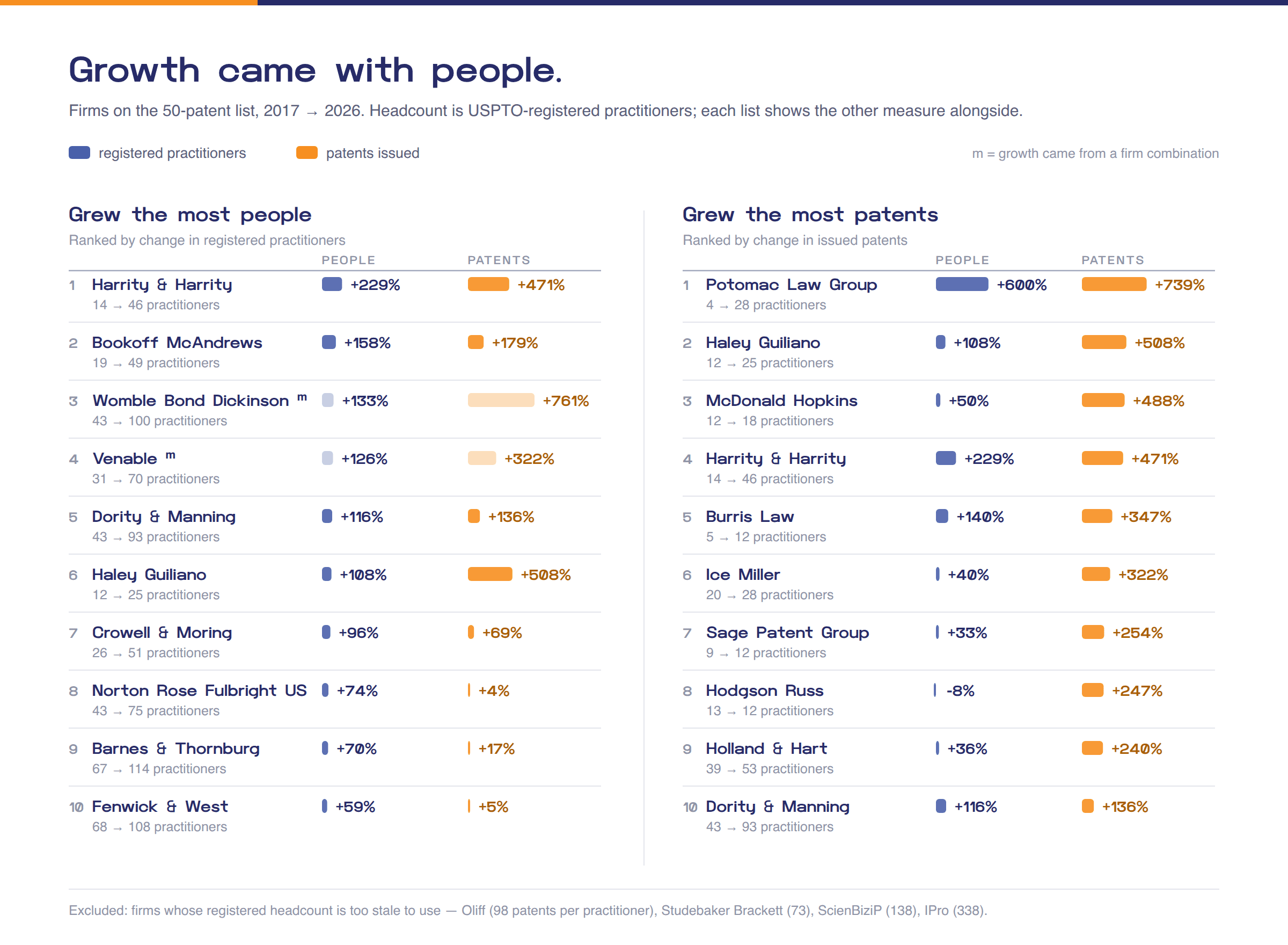
Figure 2. The ten firms that grew registered headcount fastest and the ten that grew patents fastest, each shown with the other measure alongside.
Harrity is not a cherry-pick. Rank every firm on the list by growth in registered practitioners and Harrity comes first, at +229%. Most of the firms behind it grew both measures together, and several grew people without getting much back: Norton Rose Fulbright added 32 practitioners for 4% more patents, Fenwick 40 for 5%.
A few went the other way. McDonald Hopkins grew patents 488% on 50% more people, Ice Miller 322% on 40%, Hodgson Russ 247% while its roster shrank. Whether that is real leverage or lateral hiring the roster has not caught up with, these counts cannot say. Either way it is the pattern the forecast needs, and today it is rare.
Now remove the payroll.
Agentic drafting takes the twenty to thirty hours and leaves roughly four: what to claim, how broadly, which fallbacks to build in. The typing is gone, which means the thing that gated the club is gone.
One to three years out, the decline stops. The list stands at 709 today, and continued decline would take it to 685. Expect roughly 749 instead — a reversal, and a small one. Grants trail filings by two to three years, so most of what issues by then was drafted before these tools were in use.
Four to nine years out, the lag clears. Continued decline would take the list to 645, a fifth smaller than today. Expect roughly 822 — above the 803 of 2017 — with the two bands under 100 patents a year supplying nearly all of the gain.
One assumption carries all of it: a one-attorney shop clearing 50 a year has to produce two and a half times what the average Harrity technical head produces now. Nine years of the most instrumented process work in the field moved that number somewhere between zero and 74%. Agentic drafting has to break a one-to-one relationship between people and patents. If it doesn’t, the bottom of this list stays where it is.
The top grows by promotion, and the pipeline is narrowing.
The 1,000+ band does not grow by incumbents swelling. It grows by promotion. Thirty-five of today’s 65 were there in 2017. Twenty-two came up from the 500–999 band, four from 250–499, two from further down, and two have no 2017 predecessor. Eleven of the 46 dropped out — a band that netted 19 firms churned 30 in and 11 out.
The feeder is thinning. The 500–999 band fell from 80 firms to 72, and you cannot promote firms into the top band faster than they arrive in the one below it. Hold the observed promotion rate and the 1,000+ band lands near 78 nine years out; lift it a quarter for leverage and you get 83. Trend says 92. I don’t believe it. Concentration still rises; the count of giants grows more slowly than it did.
Who staffs the bottom?
Supply is the obvious objection. New registrations ran 1,048 in FY2025, more than 40% below the late-2000s average, and the bar is old and getting older: 7,300 active practitioners with 21–25 years of experience against 4,717 with one to five.
The list counts firms, not lawyers. And the newest entrants fit the bottom of it. Of practitioners registered in the last five years, 62% are patent agents rather than attorneys, against 29% of the 2006–2010 cohort — no litigation escape hatch, no M&A rotation, closer to the technology.
The same demographics condemn the middle. The mid-sized shop that scaled by hiring is undercut from below, outrun from above, and starved of its input: the 6–10 year cohort has fallen from roughly 7,200 practitioners in 2019 to 4,720 today. Those associates weren’t hired away. They were never registered.
What to watch
The near list stops getting shorter. The one after it runs longer than 2017’s, with fewer new names at the top and many more at the bottom that are one attorney and a bench of agents. Fifty was never a moat. It was a payroll number, and payroll is the thing being removed.
So watch the 50–74 band. If it is still falling in three years, the drafting economics did not change and everything above this line is wrong.
Sources & notes
Firm counts from IPWatchdog’s 2017 rankings (803 firms, calendar 2017) and PatentBots Patentverse (709 firms, year ending Q1 2026); the windows differ, the 50-patent bar is identical. Band counts and firm-by-firm transitions computed from the full published rankings. Harrity headcount from the USPTO OED roster (December 2017, 14 practitioners), an OED practitioner search (September 2026, 46), and the firm’s own team page (130 people, 77 with technical degrees). The 2017 roster counts only registered practitioners and so understates the technical bench then, as the 2026 roster plainly does now; comparing registered to registered gives a 74% rise in output per head, which is the ceiling on that range. Prior-employer attribution is by name match against the 2017 roster and is imperfect where practitioners share names. Firm-level transitions into the 1,000+ band were reconciled by hand for mergers and rebrands (ArentFox Schiff, Osha Bergman Watanabe & Burton, Troutman Pepper Locke), which automated name matching does not catch. Grant totals: USPTO Patent Technology Monitoring Team (318,828 utility patents in 2017; ~325,800 in 2025). Both rankings are by correspondence name and include a small number of corporate patent departments alongside law firms. Practitioner demographics from the July 2026 OED roster. Figure 3 joins the USPTO practitioner rosters for December 2017 and September 2026, counting registered attorneys and agents by firm of record; firms whose roster is too stale to use are excluded (Oliff shows 98 patents per registered practitioner, Studebaker Brackett 73, ScienBiziP 138, IPro 338). Womble Bond Dickinson and Venable are marked as combinations. Trend baselines apply each band’s 2017–26 annualized rate forward three and nine years.
Paximal is an agentic, attorney-designed platform that drafts complete, fully-enabled patent applications in minutes — built to survive examination, and to keep the attorney in charge of every decision that matters. Schedule a demo.