
Strategy & Business
By Ian Schick, PhD, Esq.
Hundreds of billions of dollars are betting on AI moats. The public patent record says most of those moats have not been built.
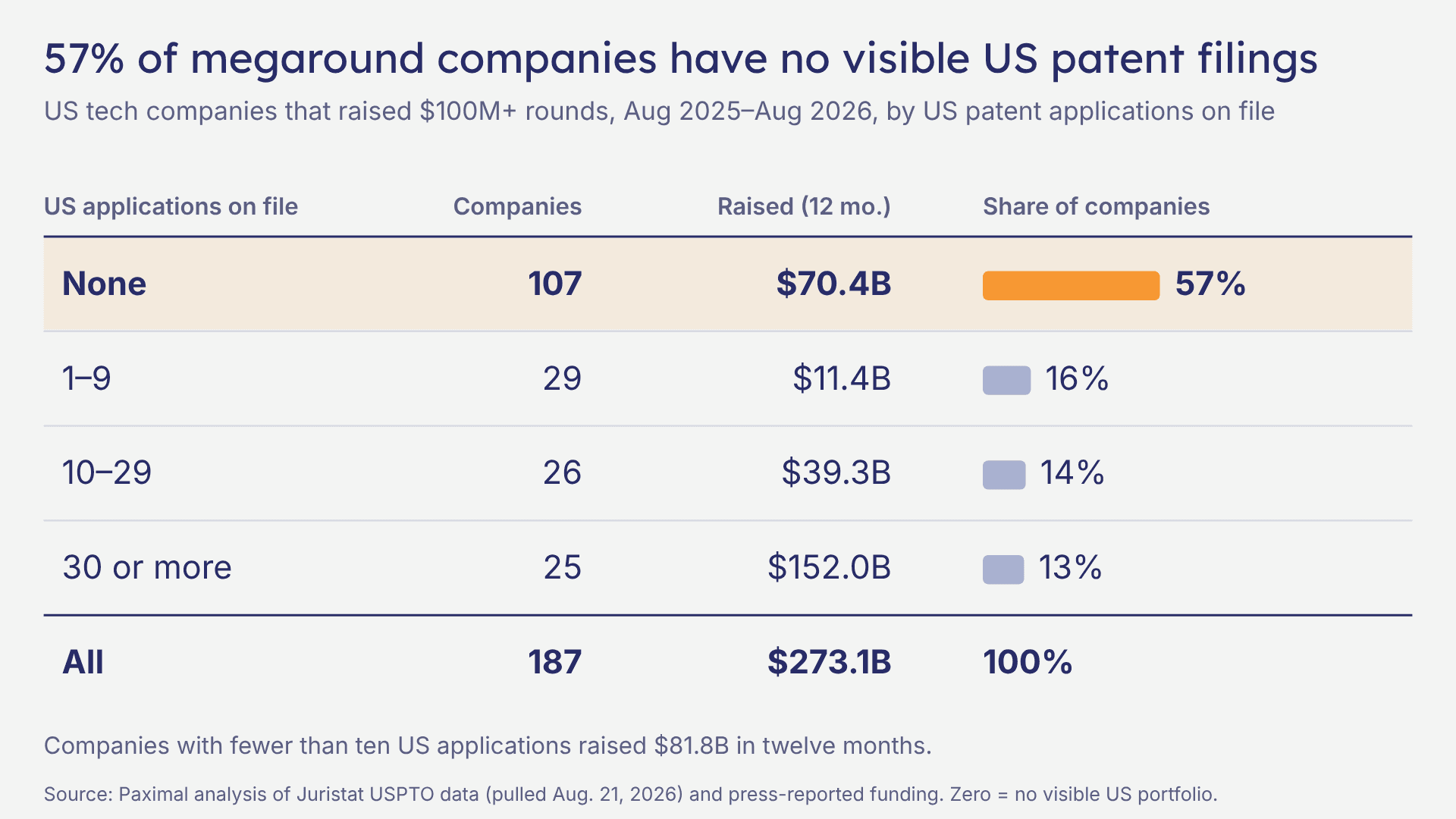
Between August 2025 and August 2026, 187 US-headquartered tech companies raised rounds of $100 million or more, roughly $273 billion in all. We screened every one against USPTO application data. 107 of them (57%) have no visible US patent applications. Another 29 have fewer than ten.
Whether or not AI is a bubble, every boom ends with the same question from investors, acquirers, and lenders: what is actually left? A valuation is a claim on future cash flows. A patent is a claim on a market. Most of this cohort holds plenty of the first and, on the public record, almost none of the second.

The bubble, by the numbers
The capital is concentrated as never before. AI took about half of global venture funding in 2025 (Crunchbase) and roughly 86% of US venture dollars in the first half of 2026, when US venture passed all of 2025 at $412.7 billion (PitchBook via SiliconANGLE). OpenAI raised $122 billion at an $852 billion valuation (SiliconANGLE); Anthropic raised $65 billion at $965 billion post-money (TechCrunch). In one advisory firm’s sample of large AI funding rounds and deals, the median price was about 24 times revenue (Aventis Advisors).
The warnings come from insiders and regulators alike. In August 2025, Sam Altman asked whether investors “as a whole are overexcited about AI” and answered: “My opinion is yes” (Fortune). The Bank of England warned that “the risk of a sharp market correction has increased” (BoE). The Nasdaq-100 entered correction territory on July 28 (Yahoo Finance), and on October 8 the FT reported that OpenAI’s annualized revenue is approaching $50 billion, about $20 billion below figures previously reported (TechCrunch).
The bull case is real too: Anthropic’s run-rate revenue rose from $9 billion at the end of 2025 to more than $65 billion by the end of July 2026 (TechCrunch). But “bubble or not” is the wrong question. Even in a fairly priced category, a few winners usually take most of the value, and many well-funded companies end up acquired, licensed, or wound down. In a wide distribution of outcomes, the floor matters as much as the ceiling. The floor is what a company owns that someone would pay for without the growth story attached.
The patent gap
We took every US-headquartered tech company reported to have raised $100 million or more between August 2025 and August 2026 and resolved each against Juristat’s USPTO assignee data (pulled August 21, 2026), counting every US application, provisionals included.

Source: Paximal analysis; funding per Crunchbase News, AlleyWatch, TechCrunch; US applications per Juristat (USPTO), pulled Aug. 21, 2026. Zero-filing dots are offset vertically to show density.
The zeros run across the whole funding axis, up to a $20 billion raise. Three patterns stand out.
The gap survives removing the giants. Excluding OpenAI, Anthropic, and xAI, 184 companies raised $101 billion, and 61% of it went to companies with fewer than ten US applications. Thirteen companies raised $1 billion or more with nothing visible on file, including Cursor, Baseten, Fireworks AI, Cognition, and Together AI.
The frontier is thin. Anthropic, valued at $965 billion, has 13 US applications on record. OpenAI has 184. SambaNova, which raised $1 billion in the same window, has 456.
It is a software gap. About three in four companies with 30 or more filings build physical things: chips, rockets, drones, reactors. OpenAI is the only AI model developer in that tier; the few software companies there, such as Databricks and Ramp, are enterprise platforms. The model and application layer, where most AI valuation sits, is where the record is emptiest. SpaceX closed its $60 billion acquisition of Cursor in August (Bloomberg Law); our screen found no US filings under Cursor or its legal entity, Anysphere.
Read the zeros carefully. Most applications stay unpublished until about 18 months after their earliest priority date (35 U.S.C. § 122(b)). Assignments are recorded late, and filings can sit under a parent, as xAI’s may now sit under SpaceX, which acquired it in February (Reuters via Yahoo Finance). A zero means no visible portfolio, not proof of none. But the blind spot cannot explain older companies such as Grafana Labs (founded 2014), Baseten (2019), or ElevenLabs (2022): anything they filed before early 2025 would have been public when we ran the screen.
Why the gap exists
The gap is the sum of reasonable-sounding decisions.
Patents seem too slow. A first office action takes 20.6 months on average (USPTO, Aug. 2026); models ship every few months. But Track One prioritized examination reaches final disposition in about five months from the grant of the Track One request (USPTO), for a $4,515 large-entity fee (fee schedule).
Trade secrets became the default. Federal trade secret filings reached more than 1,500 cases in 2025, the highest total ever recorded (Lex Machina). But secrecy protects only against misappropriation. In June, a federal judge dismissed xAI’s trade secret claims against OpenAI without leave to amend (Courthouse News). A secret is also hard to value, hard to show a buyer, and gone once it leaks.
Open weights seemed to erase moats. After DeepSeek, Nvidia lost about $589 billion in market value in a single day (Bloomberg). The better lesson: when general capability is a commodity, specific technical improvements are what is worth protecting, and that is what patents cover.
Section 101 scared founders off. In Recentive Analytics v. Fox Corp., the Federal Circuit held ineligible claims to “the application of generic machine learning to new data environments, without disclosing improvements to the machine learning models to be applied” (opinion); the Supreme Court denied cert in December (docket 25-505). But in Ex parte Desjardins, a precedential Appeals Review Panel decision, the USPTO vacated a § 101 rejection of claims that reflected “an improvement to how the machine learning model itself operates” (decision). AI applied to X is in trouble; a better way to build, train, or serve a model can be patent-eligible.
The result is a cohort that has protected its most valuable technical assets in the least transferable form available: in people’s heads, and in secrets no buyer can inspect.
What’s left when the air comes out
In a correction, patents often outlive the companies that filed them. Commerce One filed for Chapter 11 in October 2004 (Cover Pages). That December, about 40 of its patents and applications sold at auction for $15.5 million, while the rest of its assets fetched $4.1 million (InfoWorld). Nortel’s roughly 6,000 patents brought $4.5 billion in 2011 (Computing).
This cycle’s AI exits have bought people, not property. Microsoft–Inflection, Google–Character.AI, Google–Windsurf, and Nvidia–Groq were each built around hiring key staff and taking a non-exclusive license (The Batch; Groq). That route may narrow. FTC Chair Andrew Ferguson said in January that the agency is “beginning to look very closely at how these things work” (WilmerHale), and a March 2026 FTC and DOJ request for comment asks whether merger-filing rules adequately capture “reverse acquihires” (FTC). In a conventional acquisition or asset sale, diligence asks what the company owns, and “our people” is not on the asset schedule.
Patents also move capital. A startup’s first patent raises its chances of VC funding over the next three years by 47% and makes it substantially more likely to borrow against that patent (Farre-Mensa, Hegde & Ljungqvist, J. Finance 2020). When equity gets expensive and lenders want collateral, that matters more. Meanwhile, the deepest generative-AI portfolios belong to incumbents and to China: inventors in China account for about six times as many generative-AI inventions as US inventors, and the top applicants include Tencent, Baidu, IBM, Alphabet, and Microsoft (WIPO). A company with no portfolio has nothing to license, nothing to borrow against, and nothing to assert back.
Building the floor before you need it
Patents will not save a company whose product nobody buys. But the gap is cheap to close relative to the capital it protects, and no one files their way out of a down round.
Founders: file provisionals on core technical improvements before each round closes. Claim the improvement, not the application. Patent what competitors can observe or reproduce; keep secret only what never leaves the building. Put core families on Track One, and record your assignments so the filings show up under your name.
Investors, boards, and lenders: underwrite the floor, meaning what the assets would bring if the team were hired away. Ask for unpublished filings under NDA. Track IP the way you track burn.
Bubbles are judged by what they leave behind. The dot-com bust left fiber, and patent portfolios that sometimes sold for more than the rest of the business. Whether this cycle leaves property depends on decisions being made this quarter.
The question is not whether a company is worth its valuation. It is what the company owns if it isn’t.
Sources and notes
Data. Paximal analysis of 187 US-headquartered tech companies with reported rounds of $100M+, Aug. 2025–Aug. 2026 (funding per Crunchbase News, AlleyWatch, and TechCrunch; unaudited). US application counts from Juristat USPTO assignee-at-disposition data, pulled Aug. 21, 2026, provisionals included. A zero means no visible US portfolio.
Capital and valuations: Crunchbase, 2025 · PitchBook H1 2026 · OpenAI round · OpenAI revenue · Anthropic round · Anthropic revenue · SpaceX–Cursor · SpaceX–xAI · Aventis multiples · Fortune on Altman · Bank of England FPC · Nasdaq-100 correction
Law and practice: Recentive Analytics, Inc. v. Fox Corp., No. 23-2437 (Fed. Cir. Apr. 18, 2025) (opinion), cert. denied (Dec. 8, 2025) · Ex parte Desjardins, Appeal No. 2024-000567 (ARP Sept. 26, 2025; precedential Nov. 4, 2025) (decision) · 35 U.S.C. § 122(b) · USPTO pendency and Track One dashboards · USPTO fee schedule · Lex Machina · X.AI v. OpenAI dismissal · Nvidia one-day loss · WIPO GenAI landscape
Exits and research: Commerce One bankruptcy and auction · Nortel · Microsoft–Inflection · Nvidia–Groq · FTC on acquihires · FTC/DOJ request for comment · Farre-Mensa, Hegde & Ljungqvist, “What Is a Patent Worth?”, J. Finance 75(2): 639–682 (2020) (summary)